

A journey through fifteen centuries of faith and art in Paris Region
- Inspiration
- Themed guides
- A journey through fifteen centuries of faith and art in Paris Region
Ever since the Christian city of Paris first emerged fifteen centuries ago around Saint Geneviève, faith has inspired some of the region’s finest artistic expressions, championed by kings, monks and artists. Gothic cathedrals, royal basilicas, secluded abbeys, stained-glass windows and paintings all bear witness to a spirituality that has nourished art and architecture. It can be discovered in the heart of Paris’s neighbourhoods as well as along the roads leading to the abbeys, from Royaumont to Port-Royal.
Beneath the vaults of cathedrals and basilicas
Faith has left Paris Region with some of its greatest monuments, from the Gothic style pioneered at Saint-Denis to the white dome of the Sacré-Cœur.
Notre-Dame de Paris, where the Christian history of Paris begins
On the Île de la Cité beats the Christian heart of the capital. Even before the present cathedral, several places of worship stood on this site, including an ancient church dedicated to Saint Stephen. By launching the construction of the Gothic building in 1163, Bishop Maurice de Sully enshrined Notre-Dame within this long spiritual tradition, whose influence still extends throughout the region.
Since its foundation stone was laid, the cathedral has spanned more than eight centuries of history. Battered during the Revolution and later threatened with demolition, it was saved thanks to Victor Hugo’s novel, before undergoing Viollet-le-Duc’s major restoration. Following the fire of 2019, it reopened its doors on 8 December 2024, transformed: the pale stone has regained its clarity, the painted chapels their colours, the three great rose windows their splendour, and the spire once again towers over the Parisian skyline. At its summit, a golden rooster watches over the city. Installed in 2023, it houses within its core tiny relics of Saint Denis and Saint Geneviève. Now a UNESCO World Heritage Site and open to all, Notre-Dame welcomes millions of visitors from all over the world.

All around it, the Île de la Cité is perfect for a leisurely stroll. You can wander along the banks of the Seine, explore the archaeological crypt beneath the forecourt with its remains of ancient Paris, before heading to the nearby flower market or the tip of the Île Saint-Louis.
Fancy extending your visit? Set off to explore the Notre-Dame de Paris neighbourhood, nestled between the banks of the Seine and ancient ruins.
The Basilica of Saint-Denis, the birthplace of Gothic art
To the north of Paris, the Basilica of Saint-Denis – which became a cathedral in the 20th century – was built over the tomb of Saint Denis. Around this venerated burial site grew one of the most powerful abbeys of the Middle Ages, which was soon chosen by monarchs as their final resting place. From Dagobert to the last of the Bourbons, most of the kings and queens of France are buried there, beneath an exceptional collection of some seventy recumbent figures and carved tombs – one of the most significant in Europe.

It was here, in the 12th century, that Gothic art first emerged. Whilst rebuilding the church’s chancel, Abbot Suger – adviser to Kings Louis VI and later Louis VII – envisaged a building bathed in light, where ribbed vaults and vast stained-glass windows allowed coloured light to stream in. This new chancel was consecrated in 1144 in the presence of the king, Queen Eleanor of Aquitaine and numerous bishops from across the kingdom. The style it pioneered, initially known as ‘French art’, subsequently spread to the great cathedrals and flourished throughout Europe. The basilica still houses 12th-century stained-glass windows, which are among the oldest examples of this art form.
Today, the basilica is gradually regaining its original silhouette. Its north spire, dismantled in the 19th century after being weakened by a lightning strike, is being rebuilt stone by stone. ‘La Fabrique de la flèche’, a unique tour open to the public, allows visitors to follow this exceptional project, getting up close to the stonemasons, carpenters and craftsmen at work.
Explore the Basilica of Saint-Denis and its royal necropolis
The Sacré-Cœur in Montmartre, a sacred hill since Gallo-Roman times
Long before the Sacré-Cœur was built, the Montmartre hill was already a major centre of spirituality. Gallo-Roman temples there honoured Mercury and, no doubt, Mars; Christianity then took root there in turn.
Born of a vow made after the 1870 war and the Paris Commune, construction of the basilica began in 1875 in a Roman-Byzantine style characterised by its domes. Its whiteness comes from stone from Château-Landon, in Seine-et-Marne, a limestone that fades with the rain yet retains its bright lustre.
Today, people mainly climb up there for the view. From the forecourt, and higher still from the dome gallery, Paris stretches out to the horizon, from the Eiffel Tower to Notre-Dame, offering one of the capital’s most unobstructed panoramas. Below, the village of Montmartre invites you to wander amongst its stairways and steep alleyways, past the painters and portrait artists set up on the Place du Tertre, the café terraces and the small Clos Montmartre vineyard planted on the hillside. The neighbourhood has retained the bohemian spirit that appealed to so many artists.
Climb the hill to the Sacré-Cœur Basilica and its panoramic view.

In the footsteps of the saints who watched over Paris
These monuments often serve to tell the story of Paris. Yet the capital has also been shaped by spiritual figures who have left their mark on its history. From Saint Geneviève to Saint Vincent de Paul, from the early Christians to the great waves of charity, their traces can still be seen along the streets, for those who take the time to follow them.
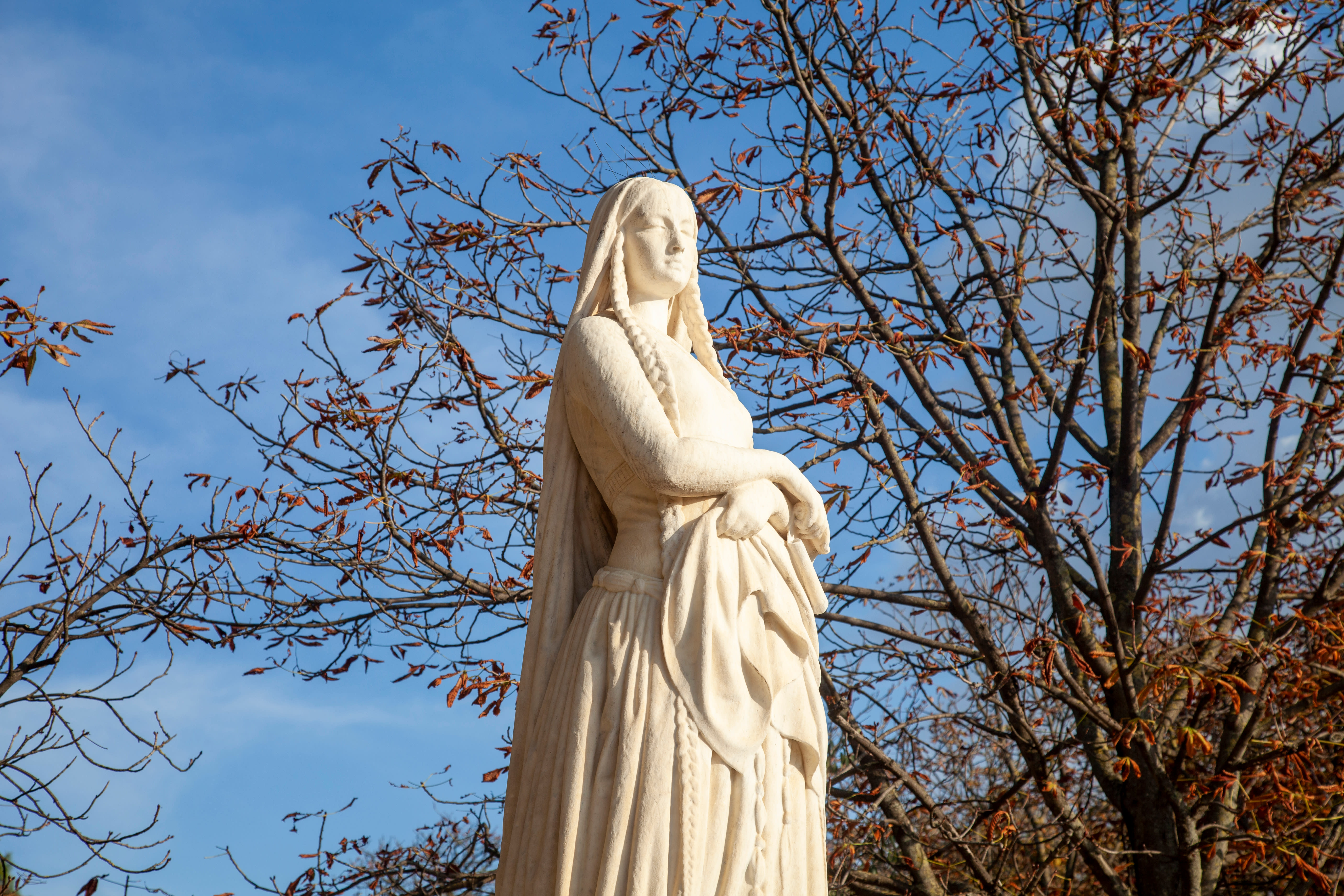
Saint Geneviève, patron saint of Paris
Born in Nanterre around the year 420, Geneviève was a young woman devoted to God when, in 451, the threat of Attila’s Huns cast terror over Lutetia. According to tradition, she urged the Parisians to remain within the city walls and to pray rather than flee. Attila ultimately bypassed the city: Geneviève became, for centuries to come, the protector of Paris. Throughout her life, she organised food supplies during famines and interceded on behalf of the first Frankish kings, Clovis and Clotilde.
On her death, at the beginning of the 6th century, she was buried atop a hill on the Left Bank, which would take her name – Montagne Sainte-Geneviève – located in what is now the Latin Quarter. Her legacy can still be traced nearby, at the Church of Saint-Étienne-du-Mont, where her reliquary is venerated, and at the neighbouring Panthéon, originally designed as a church dedicated to the saint, which the Revolution would later transform into a temple to great men. Frescoes there still depict her life.
Saint Denis and the legend of the saint who carried his own head
Another major figure in the early Christian history of Paris, Denis was, according to tradition, the city’s first bishop. Sent from Rome to evangelise Gaul in the 3rd century, he was beheaded at the summit of the hill now known as Montmartre, meaning ‘the hill of the martyrs’. Legend has it that after his execution, he rose to his feet, took his head in his hands and walked northwards for nearly six kilometres before collapsing at the spot where the Basilica of Saint-Denis now stands. This image of the saint carrying his own head has inspired generations of artists: it can be seen, in particular, on the tympanum of the basilica.

Saint Vincent de Paul, the apostle of charity
Much later, in the 17th century, another figure left his mark on the spiritual life of Paris. A priest born in 1581, Vincent de Paul devoted his life to the poor, the sick and abandoned children. He founded the Congregation of the Mission, whose members came to be known as the Lazarists, and later, together with Louise de Marillac, the Daughters of Charity. In 1632, he established his work in the Saint-Lazare enclosure, one of the largest in the city. His congregation remained there until the Revolution. It is on this site, in what is now the 10th arrondissement, that the Church of Saint Vincent de Paul has stood since the 19th century, keeping his memory alive.


Amidst the tranquillity of abbeys and enclosed gardens
Paris Region is also home to grand abbeys nestled near rivers and forests. People once came here seeking seclusion and prayer; today, they come for the charm of the cloisters and the coolness of the gardens.
Royaumont Abbey, the largest of the region’s Cistercian abbeys
The young Louis IX, the future Saint Louis, founded Royaumont in 1228 with his mother Blanche of Castile, some thirty kilometres north of Paris, amongst ponds and forests. The king took a personal interest in the construction work. From this golden age, the largest Cistercian cloister in France remains, along with a remarkable Gothic refectory and, in place of the abbey church destroyed during the Revolution, romantic ruins set amidst the greenery.
Surrounded by a park criss-crossed by canals, the abbey boasts three gardens classified as ‘remarkable’, ranging from a French formal garden to a kitchen garden and a medieval-inspired ‘garden of nine squares’. Now a cultural centre, the abbey thrives today on music and dance, with a festival bringing its walls to life every autumn.

Maubuisson Abbey: a royal convent that has become a centre for the arts
It was once again Blanche of Castile, mother of Saint Louis and regent of the kingdom, who commissioned the building of Maubuisson around 1236, near her castle at Pontoise, under the name of Notre-Dame-la-Royale. The queen brought Cistercian nuns to live there and chose to be buried within its walls. All that remains of this once-powerful abbey are elegant 13th-century buildings: the chapter house, the parlour, the nuns’ hall and a large tithe barn, surrounded by a wooded park through which medieval canals still flow. Since 2001, the site has been home to a centre for contemporary art, where works created on site interact with the austere beauty of the Cistercian stonework.

The Abbey of Vaux-de-Cernay, in the heart of the Chevreuse Valley
Founded in 1118 and affiliated with the Cistercian Order in 1147, the Abbey of Vaux-de-Cernay is said to have been home to as many as two hundred monks at its height, in a wooded valley within the Rambouillet Forest. The Revolution brought an end to monastic life and the site, converted into a stone quarry, gradually fell into ruin. In the 19th century, Baroness Charlotte de Rothschild purchased the estate and restored it to serve as a country residence. The Gothic remains of the abbey church can still be seen, standing on the banks of a pond, amidst forests and rushing waters. Completely refurbished and situated on the edge of the Haute Vallée de Chevreuse Regional Nature Park, the abbey is now a vast 80-hectare hotel estate, where guests can stay amongst the medieval ruins, dine in the monks’ former refectory and enjoy a spa.

Port-Royal des Champs, a centre of Jansenism
Founded in 1204 in a small valley within the Chevreuse Valley, this Cistercian convent enjoyed its golden age in the 17th century, under the leadership of its abbess, Mother Angélique Arnauld, who restored a strict rule of poverty and silence. Port-Royal then became the centre of Jansenism, a demanding spiritual movement committed to austerity and the primacy of divine grace. Great minds of the Grand Siècle, such as Blaise Pascal and Jean Racine – a former pupil of the famous Petites Écoles – gathered around the abbey. Deemed too independent in the face of authority, the community was dispersed, and the abbey was subsequently razed from 1710 onwards on the orders of Louis XIV.
All that remains of the original abbey are mainly its foundations, visible amidst a wooded estate covering some thirty hectares. The memory of the site, preserved over the years by the faithful of Port-Royal, is brought to life today at the national museum housed in the former ‘Petites Écoles’ building, where visitors can admire Philippe de Champaigne’s finest masterpieces. The estate also features a well whose mechanism was designed based on Pascal’s calculations, an orchard of heritage fruit varieties, and gardens that evoke the nuns’ agricultural way of life.

Notre-Dame du Lys Abbey, Cistercian ruins near Melun
In 1244, Blanche of Castile founded a new abbey for nuns, Notre-Dame du Lys, to which her son Saint Louis granted lands and revenues. The first nuns came from Maubuisson and, when the queen died, her heart was laid to rest here, whilst her body was buried at Maubuisson. Burned down during the Hundred Years’ War, rebuilt, then left to be plundered after the Revolution, the abbey gradually lost its buildings. Today, beautiful Gothic remains survive: the choir, the transept and their chapels, set off to their best advantage in a public park where people come to walk and have picnics, a few kilometres downstream from Melun.

The Jardin des Missions Étrangères, a hidden gem on Rue du Bac
Hidden behind a high wall on Rue du Bac, in Paris’s 7th arrondissement, lies one of the largest private gardens in Paris. Created in the 17th century for the Foreign Missions Seminary, which trained priests destined for Asia, it was designed by a pupil of Le Nôtre, with its green lawns and straight, French-style paths. A gazebo topped with a Chinese-style roof and a few plants from the Far East serve as a reminder of those distant missions. From his nearby window, Chateaubriand loved to gaze upon this glimpse of greenery, which he describes in his Mémoires d’outre-tombe. Discreet and well-preserved, the garden opens its gates to the public during Heritage Days and the Fête des Jardins.
A journey through museums and sacred treasures
Faith has also inspired masterpieces that can be admired today in the museums and monuments of Paris Region, ranging from medieval sculpture and grand stained-glass windows to 19th-century paintings.
The Louvre: from religious painting to medieval art
Before becoming a museum, the Louvre was a royal palace, and its collections bear witness to a long Christian history. In the galleries dedicated to medieval art, ivories, enamels and Madonnas and Childs shine out, such as the delicate ivory statuette from the Sainte-Chapelle. Further on, the paintings unfold centuries of sacred subjects, from the altarpieces of the Italian and Flemish Primitives to Veronese’s immense The Wedding at Cana, a biblical scene which faces the Mona Lisa.

The Sainte-Chapelle and its stained-glass windows
Situated on the Île de la Cité, a stone’s throw from Notre-Dame, the Sainte-Chapelle was built by Saint Louis in the mid-13th century to house the Crown of Thorns, which is now kept in the treasury of Notre-Dame. Its fifteen stained-glass windows, fifteen metres high, depict over a thousand scenes from the Bible, from Genesis to the Book of Revelation. On a clear day, the light streams through this wall of blues and reds, transforming the upper chapel into a kaleidoscope of colour.

The Cluny Museum, the Middle Ages and the Sacred
In the heart of the Latin Quarter, housed in the former residence of the Abbots of Cluny and built on the site of Gallo-Roman baths, the National Museum of the Middle Ages brings together a thousand years of medieval art. The sacred collection is vast, featuring church sculptures, gold and silverwork, enamels and stained-glass windows, including several panels from the Sainte-Chapelle and the heads of the kings of Judah, which were once removed from Notre-Dame during the Revolution, then recovered and housed here. Visitors can also admire the famous ‘Lady and the Unicorn’, a tapestry woven in the late 15th century. Adjacent to the museum, a medieval-inspired garden extends the visit into the open air.

The Musée d’Orsay: Symbolism and Spirituality
Housed in a former railway station on the banks of the Seine, the Musée d’Orsay is best known for its Impressionist masterpieces. Its collections also bear witness to a religious inspiration that characterised the late 19th century. Symbolists such as Gustave Moreau, Puvis de Chavannes and Odilon Redon explored dreams, mystery and the sacred in their works. Alongside them, the Nabis revitalised religious imagery, following the example of Maurice Denis, a devout Catholic, whose paintings reimagined the great scenes of the faith in vivid, stylised colours.

To the sound of sacred music
In Paris Region, faith resonates through music. Beneath the vaulted ceilings of churches, grand organs and concerts offer a vivid way to experience spirituality.
Listening to the grand organs
Paris Region is home to some of France’s greatest organs, which can be heard almost every week. At Saint-Sulpice, in Paris’s 6th arrondissement, Aristide Cavaillé-Coll’s immense instrument resounds during recitals following Sunday mass. Not far away, Saint-Eustache and its monumental organ host recitals and premieres, whilst the Church of La Madeleine continues a musical tradition cherished by Camille Saint-Saëns and Gabriel Fauré. At Notre-Dame, the grand organ, newly restored at the end of 2024, once again fills the nave with its notes.

Sacred music in exceptional venues
But it is also the venue itself that makes the concert so moving. Beneath the thousand glass panes of the Sainte-Chapelle, ensembles perform a repertoire of classical and sacred music in the evenings. In Versailles, the Royal Chapel regularly hosts the Baroque music for which it was built – the very music that was once performed before Louis XIV, accompanied by its organ and choirs. And beneath the vaults of the Cathedral of Saint-Louis des Invalides – the soldiers’ church situated at the heart of the Hôtel des Invalides – the works of the greatest classical composers resound each year as part of the Invalides Music Season.
Over the centuries, faith, history and art have shaped Paris and its region. Following in their footsteps offers a unique perspective on the city, whether you are a believer or not.